
17/09/ · A vesting period is the time an employee must work for an employer in order to own outright employee stock options, shares of company stock or employer contributions to a tax-advantaged retirement plan. Vesting periods come in a variety of durations. For retirement contributions, they are limited by government rules, while share and option vesting periods are generally Estimated Reading Time: 4 mins 27/07/ · When employees participate in stock option plans or accept stock options as a form of compensation, businesses enforce what they call a vesting period. This period is usually a number of years participating employees must work for the company before they can receive the full benefit of their option What Is the Meaning of Vesting Date in Stock Options? Employee Stock Options. All kinds of companies give their employees stock options as incentives. If the strike Vesting Date. When you get an incentive stock option, you typically can't use it right away. It wouldn't be much of an Author: Cam Merritt
What Is the Meaning of Vesting Date in Stock Options? | Pocketsense
Stock options are becoming a popular method vesting period of stock options employee compensation. This is especially seen in startups, where cash needs to be conserved, equity compensation in the form of stock acts as a competitive recruitment tool, vesting period of stock options. In this article, vesting period of stock options, we take a closer look at one category of equity compensation, the non-qualified stock option.
We will explore the basic concepts associated with this category of stock option and compare it with other popular ones, especially in terms of taxation. Non qualified stock options are the most preferred equity compensation method used by employers.
But to vesting period of stock options how this works in favor of the company, one must understand the basics of equity compensation for employees. When an employee is granted stock optionsit translates as the right to buy company shares at a fixed price on the grant date. This is a special privilege granted to employees of a company in comparison to external shareholderswho if interested, have to buy company shares at the going market price.
Stock options provide the employees with an opportunity to become shareholders in their company of employment. There are three forms of equity compensation: Incentive stock options ISONon qualified stock options NSOand Restricted stock units RSU. Each one varies in terms of their exercising options and taxation policies. But the basic idea is, using these instruments employers engage new talent in the business with the accountability of delivering their best. Only if the business grows and makes a profit, the value of equity will grow and in turn, employees benefit from their stock options.
Non qualified stock option NSO is one where employees are taxed both while purchasing the stock exercising options as well as while selling the stock. Using this option, employers benefit from tax deductions, but employees end up paying higher taxes. Though both are methods of equity compensation, it is interesting to observe the differences between NSO vs ISO. The following table consolidates some of the basic features in which these two stock options vary from one another:. As discussed earlier, employees holding non qualified stock options face vesting period of stock options taxation ; First while purchasing the stocks at the strike price and then while selling the stocks at market rate.
At sale — The sale stage offers three options to employees :. When an employee actually becomes eligible to exercise their options will depend on the non qualified stock options vesting. Vesting ensures that employees stay committed to the growth of the company.
If the business posts a positive growth, so does the price of stocks. On vesting, an employee has to choose from one of these 3 options:. Either way, taxes will be levied both at purchase and sale of non qualified stock options. An employee can choose to use cash or go cashless while exercising these stock options and paying for taxes.
Emily joins a Company ABC as a design specialist in June Here the vesting schedule spans 5 years. An employee stock option is a powerful tool for startups.
It provides the much-required incentive and remuneration for fresh talent joining the company, vesting period of stock options. Since a vesting period of stock options environment is highly dynamic and demanding, vesting period of stock options, holding stock options in the company they are building, makes the employees feel directly involved in the business.
Thus to keep all records clean and updated, vesting period of stock options, it is best to use sophisticated software such as Eqvista that easily helps issue, track, and manage employee stock options. As the company grows and expands, Eqvista is capable of handling stock options of the top management and multiple investor rounds as well. Here are our other offerings related to company equity management.
To discuss further, reach us today. If you want to start issuing and managing shares, Try out our Eqvista Appit is free and all online! Non Qualified Stock Option Non qualified stock options are the most preferred equity compensation method used by employers, vesting period of stock options. What is a stock option? In cash strapped startups, cash compensation is not readily available to recruit the best talent. In this situation, equity compensation in the form of stock options comes in handy.
Employee compensation packages are designed in a way that stock options in the company form a major part of the deal, and the rest compensated with cash. Non qualified stock options are unique in a way that they carry features of both ISO and RSUs. Their tax restrictions are similar to RSUs and their control over employee engagement is similar to ISOs.
This example of exercising and selling the stock at different dates show what affect the taxes can play on your overall gain. However the tax effect may change greatly if the stock price stays the same or declines over time. GET STARTED. Categories a Valuation Angel Investors Business Valuation Cap Tables Employee Stock Option FAST Agreement Financial Modeling IPO Issue Shares Venture Capital Vesting period of stock options Vesting.
Popular posts Top Active Angel Investors List for Startups Google Employee Benefits: Google Stock Units GSUs Best Active Venture Capitalist Firms for Startup Funding. Granted to all stakeholders: employeesdirectorsconsultantsadvisorsand others.
During the grant, the strike price must be at least similar to the current fair market value of stocks. During the grant, vesting period of stock options, if the strike price is lesser than the current fair market valuethe price difference is considered deferred compensation.
If an employee waits for at least 2 years from the grant dateholds on to the stock for at least 1 year after exercising optionsand continues employment in the company for at least 3 months before the sale date, if all these 3 criteria are met, they become eligible for the special long-term capital gain tax rate. After exercising stock options, if the stocks are held for less than 12 months — short term capital gain rates are levied similar to ordinary income tax.
Employee Stock Options Explained
, time: 9:29Non Qualified Stock Option (NSO): Basic Guide
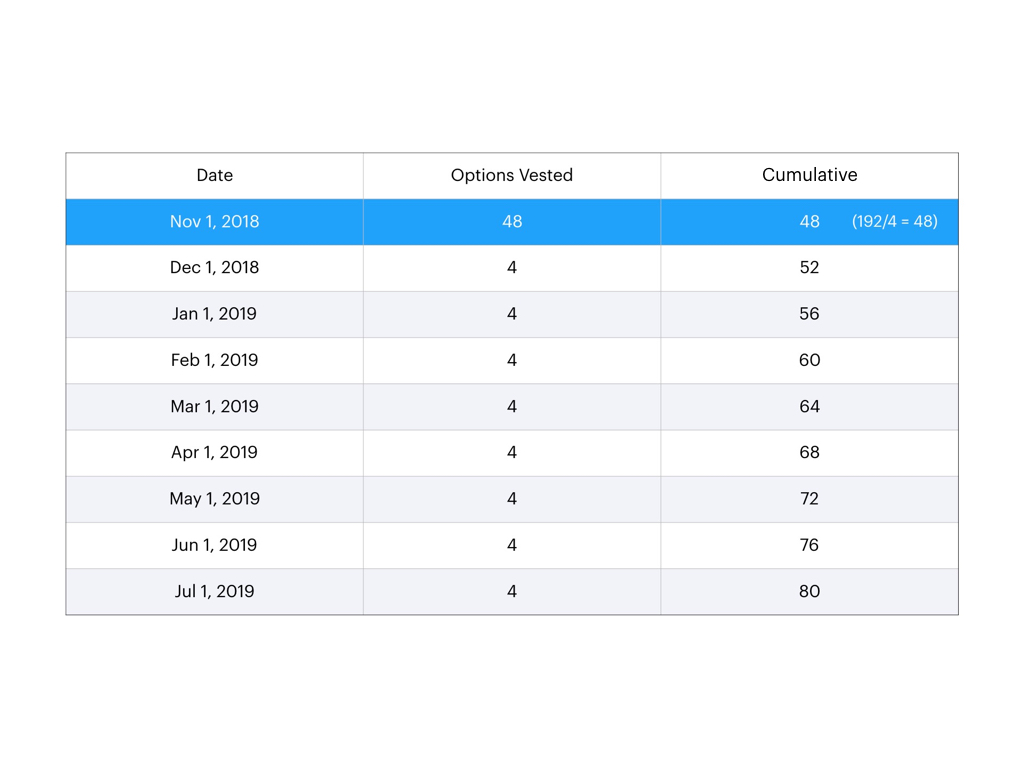
17/09/ · The options agreement will provide the key details of your option grant such as the vesting schedule, how the ESOs will vest, shares represented by the grant, and the strike price 11/07/ · With time-based stock vesting, you earn options or shares over time. Most time-based vesting schedules have a vesting cliff. A cliff is when the first portion of your option grant vests. After the cliff, you usually gradually vest the remaining options each month or quarter. Many companies offer option grants with a one-year cliff Vesting is a time period that is set by the company that the option holder has to wait (or a metric that the company has to meet if there is a “performance metric” on the vesting schedule), before they can exercise the option

No comments:
Post a Comment